AI Automation Without a Single Point of Failure
A practical way to design API-powered workflows with provider limits, fallback routing, graceful degradation and clear admin alerts.
Adding an AI API to a workflow can make a feature feel intelligent. Making that workflow dependable requires a different kind of engineering.
Providers can slow down, impose quotas, change response formats or become unavailable. A useful system must understand those limits and protect the user experience when something goes wrong.
1. Start with the task, not the model
Define what the user needs: summarization, document classification, search results, transcription, structured extraction or some other outcome.
Write down the input and output contract. For structured tasks, specify required fields, data types and validation rules. Decide what counts as a usable result and what should trigger a retry or fallback.
2. Separate orchestration from providers
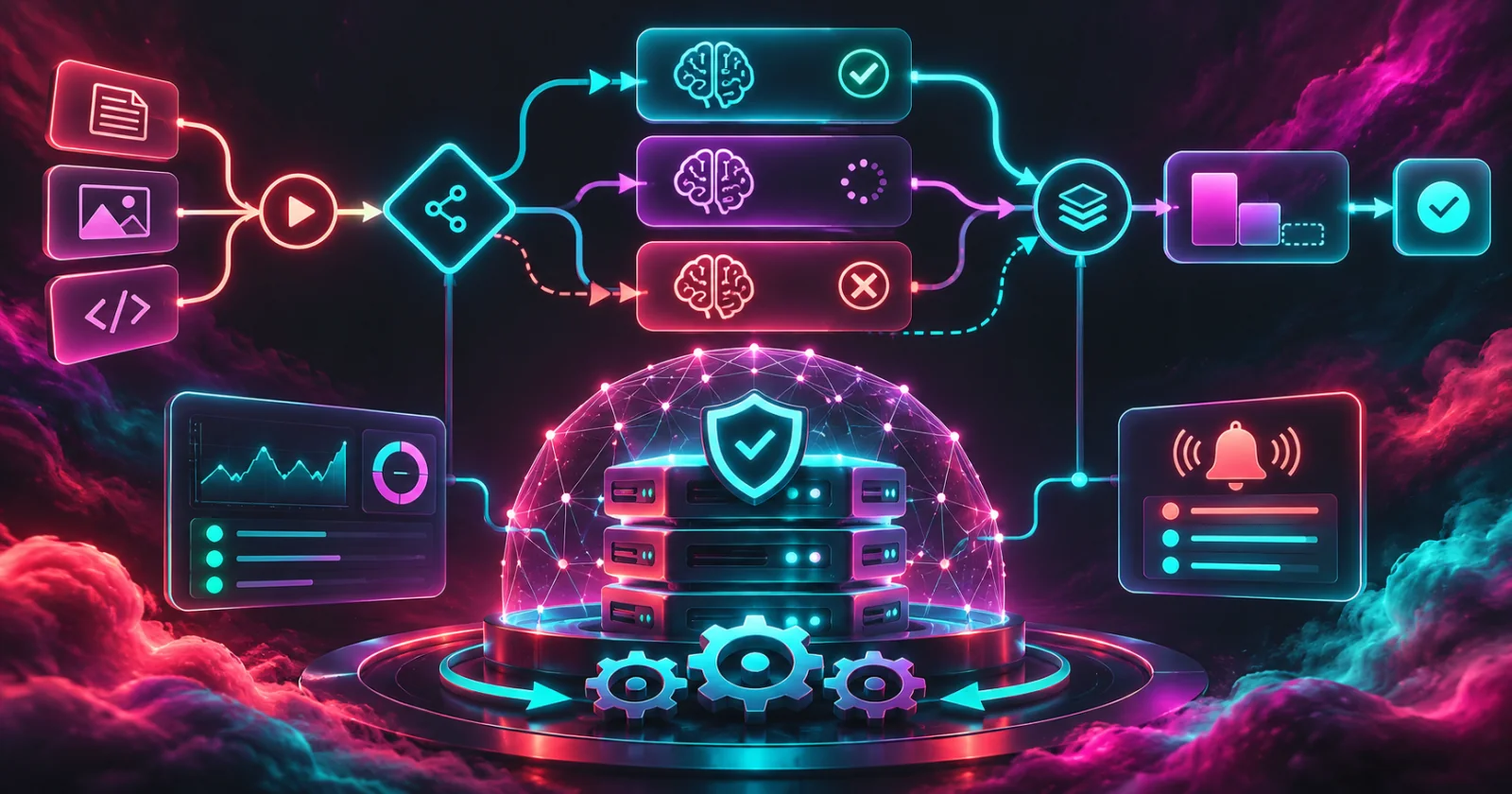
Treat each provider as an adapter behind a shared interface. Your application should not have to rewrite its main workflow when a provider changes.
An adapter can normalize input, handle authentication, map provider errors into a shared format and validate the output.
This also lets you replace a provider without rebuilding the product.
3. Choose fallback by capability, not simply by price
A fallback provider must actually support the required language, context length, output format and quality threshold.
A lower-cost model may be excellent for a straightforward classification task but unsuitable for a long document requiring precise extraction.
Maintain a capability matrix, and route tasks only to compatible providers.
4. Handle quotas and rate limits deliberately
Track per-provider quotas, concurrency limits and estimated remaining capacity. Avoid repeatedly sending requests to a provider that is clearly rate limited.
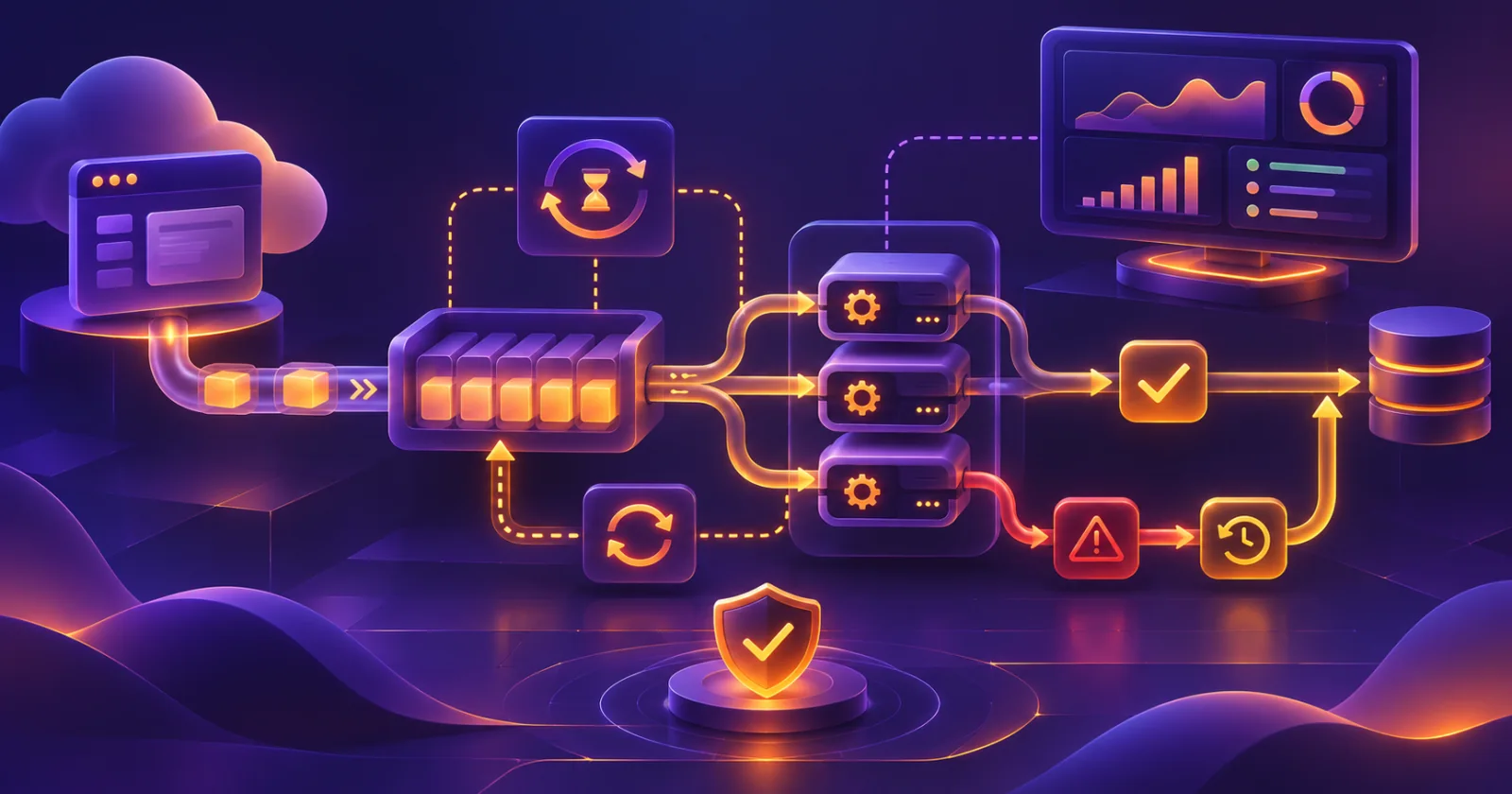
Use short timeouts, bounded retries with backoff and circuit breakers for persistent failures.
Keep provider secrets on the server, never in the browser.
5. Validate outputs before using them
Text that looks plausible may still be invalid. For structured extraction, parse and validate the returned schema. For search-assisted answers, preserve source references and distinguish verified findings from uncertain statements.
If an automated output will trigger a consequential business action, introduce stronger verification or a human review step.
6. Design graceful degradation
What happens when no acceptable provider is available?
Depending on the task, the system might return cached results with an accurate freshness label, queue the request for later, offer a non-AI workflow or explain that this specific feature is temporarily unavailable.
Do not claim success when the system did not complete the task. A partial capability can be better than a fully broken experience if the limitation is clear.
7. Build observability into the routing layer
Monitor success rate, latency, invalid outputs, quota exhaustion and fallback frequency for each provider.
Configure alerts for administrators when an account is suspended, credentials expire or all compatible providers are unavailable.
Do not expose API tokens or customer-sensitive prompts in monitoring dashboards.
8. Consider cost and quality together
Free API allowances can be useful for experimentation and low-volume workloads. They are not guaranteed capacity and can change.
Measure actual cost per usable result, including retries and fallbacks. A cheap request that often fails may be more expensive operationally than a reliable alternative.
9. Test realistic failures
- The primary provider times out.
- A second provider returns malformed JSON.
- An API key expires.
- A quota is exhausted halfway through a batch.
- The same request is accidentally submitted twice.
- A provider is slow but technically reachable.
Each case should have an intentional recovery route and an understandable user-facing state.
The central principle
AI is one component of the system, not the system itself.
The most useful automation continues to behave predictably when a model is unavailable, uncertain or simply not the right tool for the job.
Define the fallback contract before choosing providers
A provider list alone is not a resilience strategy. Before routing a request, define what an acceptable result looks like: supported input types, required output fields, data handling rules, maximum latency and a cost ceiling. Only an alternative that can meet that contract should be eligible as a fallback.
A practical routing policy should answer five questions:
- Can the provider perform this task? Route by capability, not only advertised model quality or price.
- Is this failure retryable? Treat rate limits and temporary transport failures differently from invalid requests or unsupported inputs.
- Is the outcome already known? Use correlation IDs and reconciliation for actions with external side effects before attempting them again.
- What is the fallback budget? Cap total attempts, elapsed time, spend and concurrency so a degraded provider cannot trigger an uncontrolled retry storm.
- What does the user see? Return a validated result, a clearly labeled reduced-capability response or an honest actionable failure.
For sensitive inputs, confirm that fallback providers meet the same security and data-processing constraints. Availability is not a reason to silently send customer information to a service outside the agreed boundary.
Run deliberate failure drills
Build a small set of repeatable tests, using synthetic requests rather than private client data:
- Primary provider responds with a rate limit.
- Primary provider times out after accepting an operation.
- Alternate provider returns syntactically valid but unusable output.
- Two provider routes fail simultaneously.
- The usage budget is exhausted mid-workflow.
- An alert fires repeatedly for the same underlying incident.
Record which route was selected, why it was selected, the total retry count, latency, validated output and whether an operator intervention was required. Measure useful completion rate instead of only counting successful HTTP responses.
Real implementation context: connecting intelligence to business decisions
The [LeadNoria B2B intelligence project](/projects/leadnoria/) is organized around an eight-stage workflow: business discovery, qualification, website auditing, service matching, decision-maker research, contact verification, CRM and reply analysis. The project's technical stack includes Python, n8n, Scrapy, Ollama and PostgreSQL.
This architecture illustrates a central automation design principle: each stage should produce structured, traceable information that the next stage can validate and use. Source provenance, business-fit rules, clear processing states and quality checks help turn isolated automations into one understandable workflow.
For buyers planning AI-assisted operations, the implementation framework is:
- Define the business objective: Identify the input, decision to support, required output and owner of the final action.
- Connect the workflow: Map integrations, databases and automation steps, including the information passed between stages.
- Add provider-aware routing: Choose AI or API providers by capability, data requirements, limits and cost controls.
- Validate before acting: Check output format, evidence, confidence and the next stage's acceptance requirements.
- Monitor operations: Track provider responses, fallback decisions, queue health and completion status.
What a business receives from this approach
A useful automation delivery includes a workflow map, integration inventory, validation rules, fallback strategy, monitoring view and a clear handoff process. This keeps the project tied to a practical business need rather than a collection of disconnected API calls. Explore [LeadNoria](/projects/leadnoria/) and [AI automation services](/ai-automation/) for further context.
Further reading and related work
AWS explains how to limit retries with exponential backoff and jitter. OpenTelemetry's traces, metrics and logs help reveal what actually happened across providers. Explore [LeadNoria](/projects/leadnoria/) and the [AI automation services](/ai-automation/) page for related system-building context.
Explore my services and project work, or reach out with your specific challenge.
Discuss a project ↗